
Solutions › Embedded Edge AI › Warehouse Dispatch Traceability & Verification

Dispatch Traceability

Coming soon

Embedded Edge AI · Every parcel verified and traced at the dock, before it leaves

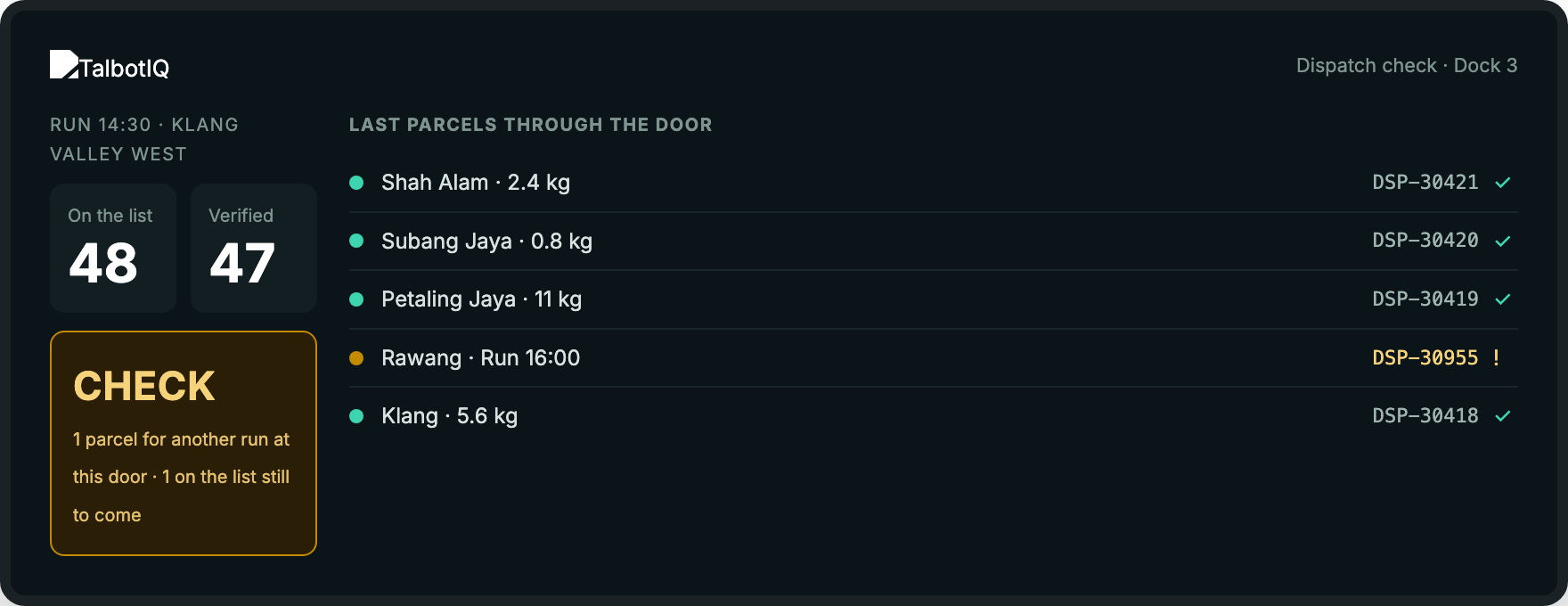
A camera at the dock door checks every parcel as it is loaded: the label read, the parcel matched to the dispatch list, the right run and the right door confirmed, and a photo kept with the record. The model is designed to run on a small computer at the dock, so a wrong or missing parcel is flagged while the door is still open, and the pictures never leave the building.

Designed to run on hardware on your premises. The footage stays where it was taken.

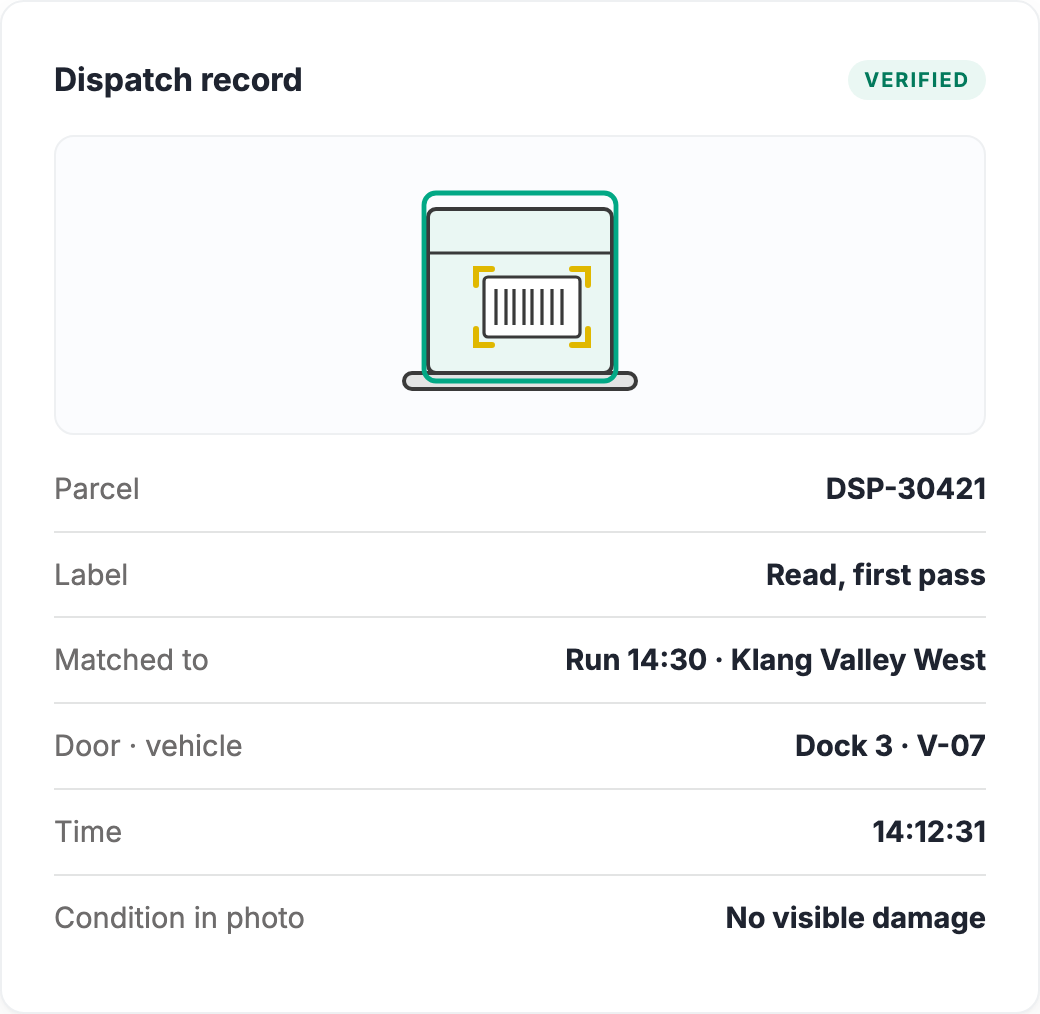
Illustration of the planned dock screen, with example data. It is not a recording of a live dock.

Found after it has left

Today, a dispatch error is usually found at the other end. Parcels are loaded against a printed list or a handheld scan, and it is the depot, the driver or the customer who finds the one that is missing, wrong or damaged, long after the vehicle has left the dock.

The mistakes are ordinary ones, and none of them is anybody being careless:

A parcel on the wrong vehicle. Two runs load side by side, the boxes look alike, and one goes on the wrong truck. It is found a day later, in the wrong town.

A short or an extra parcel. The list says 48. The vehicle leaves with 47, or with 49, because nobody counted again at the door.

A label nobody could scan. Torn, smudged or facing the wall, so it was ticked off by eye instead of read.

No proof of what left, or in what state. When a customer says a box never arrived, or arrived crushed, the dispatch record is a tick on a list.

 
Clipboard or handheld scan
Camera at the dock
Checked per action
One parcel
Everything passing the door
A wrong run is found
At the depot or by the customer
At the dock, with the door still open
A missing parcel is found
After the vehicle has left
Against the list, before loading ends
Proof of dispatch
A tick or a scan time
A photo, the label read, the time, the door and the vehicle
Condition at handover
Someone's recollection
What the photo shows
Needs the internet
Depends on the system
No; it runs on site

Comparison of method, not a benchmark. Dock throughput and the share of labels read first time are measured at the site survey, on your parcels.

Five steps at the door

In this order, on every parcel. None of them is optional, and each one is recorded against the photo it came from.

Approach

A parcel, pallet or cage reaches the dock door. Nobody presses anything.

Photograph

The camera above the door sees the parcel and its label as it passes.

Read

The label is read, so the parcel is identified from the same photo.

Match

Checked against today's list: right parcel, right run, right door.

Trace

Photo, label, time, door and vehicle are saved as one record.

Label read. The parcel is identified from its label, in the same photo as the parcel itself, not by a separate scan.

Matched to the run. Each parcel is compared with the dispatch list for that door and vehicle. A parcel for another run is flagged at once.

Counted against the list. The screen shows how many of the list have passed the door, and which are still to come.

A hold names the parcel. Something unread, unlisted or for the wrong run is shown with its photo. A person decides; the system does not overrule the list.

A record you can search. Look a parcel up by its label and see the photo, the time, the door and the vehicle.

One parcel’s record, with example data. Search by label to find the photo, the time, the door and the vehicle.

Where the work happens

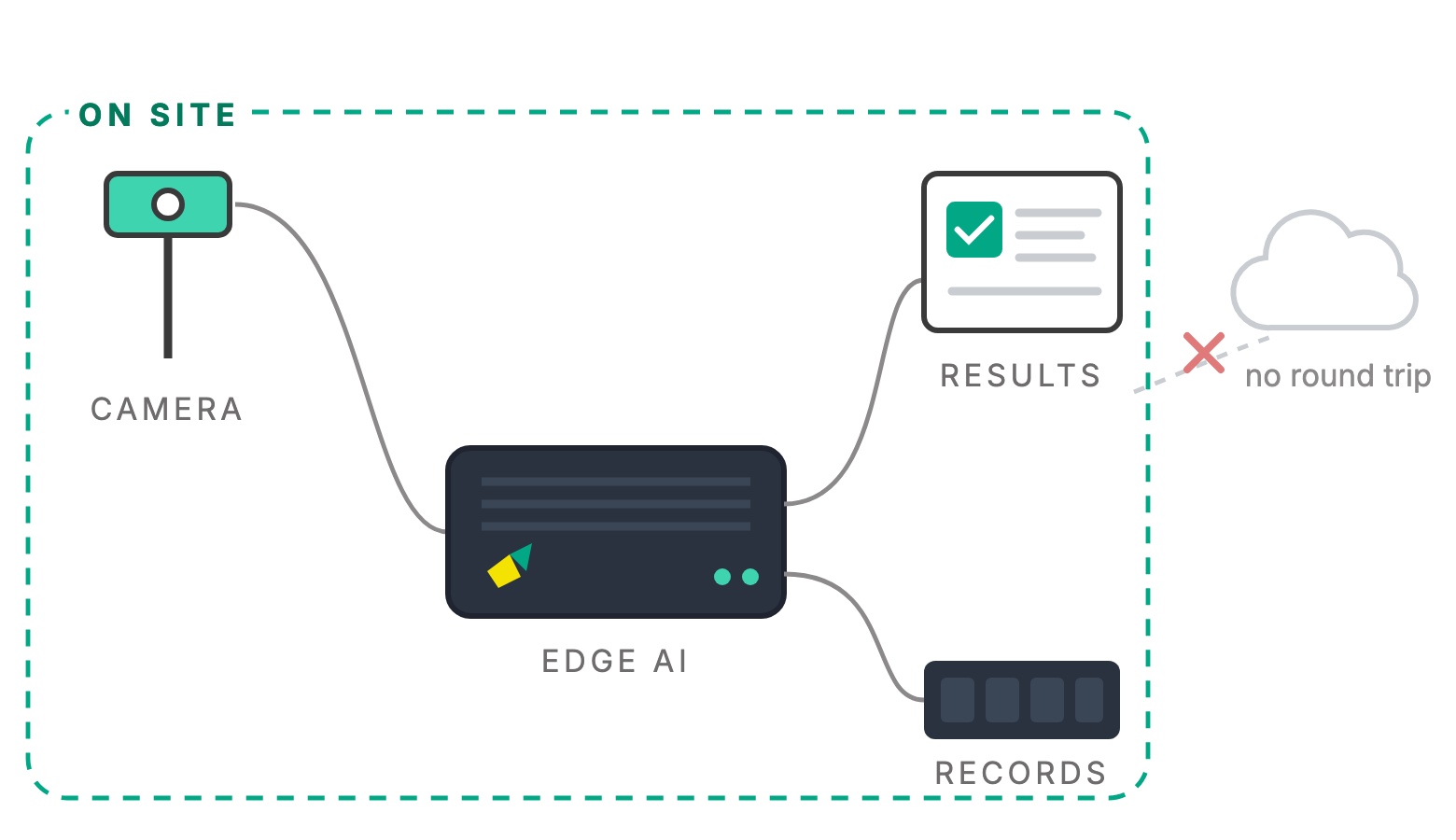
The model is designed to run on a small computer at the dock. The camera sends its picture a few metres, not to a data centre, so a flag appears while the door is still open and the pictures stay on site.

This is the same architecture as our Embedded Edge AI work: the model is layered onto hardware you already own, and the decision is made at the point of capture.

A flag while the door is open

A wrong parcel is cheap to fix before the vehicle moves and expensive afterwards. The check happens at the door, not after a round trip.

The pictures stay on site

Photos of parcels, vehicles and dock staff are processed where they are taken. What leaves, if anything, is the record and the result.

It keeps running offline

The back of a warehouse is not always well connected. Checks carry on through an outage, and records catch up when the link returns.

Four checks at every door

Each dock door gets the same four questions answered for every parcel, so the answers are comparable from door to door and day to day.

Parcel

Is it the right parcel?

Label read
Barcode or QR code
Parcel not on the list
Label hidden or damaged
Built to give you

Every parcel identified from its label, and anything the system could not read held for a person rather than guessed.

Consignment

Is everything there?

Parcels counted at the door
List lines ticked off
Short and extra parcels
Duplicates
Pallets and cages
Built to give you

How many of today’s list have passed the door, which are still to come, and what is missing when loading ends.

Door & vehicle

Is it going the right way?

Dock door
Vehicle expected at the door
Run or route
Parcel for another run
Time spent loading
Built to give you

A parcel for another run flagged at the door, and how long each vehicle spends loading. The vehicle comes from your dispatch schedule.

Condition

What did it look like when it left?

Photo at the door
Visible damage
Crushed or wet packaging
Pallet wrap intact
Timestamp
Built to give you

A picture of every parcel as it left, to settle a dispute about condition. It records what is visible; it does not see inside a box.

Running
Warehouse tray QC

One photo per tray, items counted, barcodes read against the order, pass or hold. The same on-site approach this page builds on.

Coming soon
Dispatch verification

Being prepared on the same on-site approach. We will say when it is proven, and where, rather than before.

The hard cases, on purpose

A model trained only on tidy, well-lit parcels with the label facing up fails on the first busy evening. These are in the plan for training deliberately, because they are what a real dock looks like.

A label facing away or underneath

If the label cannot be seen, the parcel is shown as present but unread and held. It is never guessed from its size or shape.

Glare on shrink-wrap

Reflective pallet wrap throws a bright streak across the label. It is a standard test, not an edge case.

Torn, smudged or curved labels

A label on a bag is bent away from the camera, or half peeled. Read when there is enough of it to be sure, flagged when there is not.

Parcels stacked, or in cages

Roll cages and pallets hide labels behind other parcels. Those are reported as not yet read, and a person turns the parcel instead of the system guessing.

Look-alike boxes, different runs

Identical brown boxes, different destinations. The label decides, never the box, and parcels are never matched by how they look.

An open door behind the parcel

Daylight or headlights beyond the door turn a parcel into a silhouette. Exposure at the door is part of the site survey.

A parcel loaded twice

Put back on the stack and picked up again, a parcel passes the door twice. It is counted once.

People and forklifts in the frame

Staff, pallet trucks and forklifts cross the view all the time. They may block it briefly; they must not be taken for a parcel, or hide one for good.

On cameras and people. Because the analysis runs at the point of capture, the result can leave the site without the footage having to. For dispatch, the record of a parcel is usually the whole requirement; the dock staff who appear in the picture are not the subject of it. What is lawful for a camera to do differs by premises and by country, so each deployment is scoped against where it is installed, with signage and retention agreed before anything is switched on.

And what it is not, plainly. It is not a cloud service: nothing needs to be uploaded for it to work. It does not replace your warehouse or transport system; it checks against the dispatch list it is given. It does not overrule a person: anything it cannot confirm is held for someone. It does not see inside a closed box; it records what is visible. And it is coming soon, not in service. The Warehouse QC tray check is the one running today.

Frequently asked

It is coming soon. Warehouse QC, the tray check, is running today; dispatch verification uses the same on-site approach and is being prepared. Register interest if you want your dock to be one of the places it is proven in. We will say when it is proven, and where, rather than before.

No. Your warehouse or transport system stays the record of what should leave. The camera checks what actually passes the door against the dispatch list it is given, and sends back the result. How the list reaches it is agreed at the site survey.

Often, as the fallback. Where the camera can read the label as the parcel passes, the handheld scan stops being the only check. Where it cannot, the parcel is flagged so that a person can turn it or scan it.

The parcel is shown as present but unread, with its photo, and held for a person. The system never guesses a parcel from its size or shape, and never passes one it could not identify.

No. The model runs on a small computer at the dock, next to the camera. What it produces, the label read, the match and the record, is what you choose to send anywhere. The pictures themselves stay where they were taken.

Often not. A site survey checks whether the cameras you already have see the parcels and their labels as they pass the door. At a dock, the angle and the light at the door usually matter as much as the camera itself, so the survey says where a camera needs to be, and why.

It keeps a photo of each parcel as it left the dock, so a dispute about condition can be settled against a picture. It records what is visible on the outside. It does not open boxes or judge what is inside them.

Quote-based, after a site survey, because the price depends on how many dock doors and cameras there are and whether the existing hardware can be used. There is no public price list.

See it at your dock

A site survey looks at your dock doors, the cameras you already have, the light at the door and how your dispatch lists are produced. You get a straight answer on what it would verify and what it would not.